


The Last of Us premiered on Max in January 2023, and swiftly took the world by storm with its riveting story, thrilling twists, and exceptional production value. Based on the video game developed by Naughty Dog, the series was written and produced by Neil Druckmann (creator of the game) and Craig Mazin (creator of Chernobyl). The story is set in a world ravaged by a fungal pandemic and follows the journey of Joel and Ellie, two survivors brought together by fate.
We sat down with producer Greg Spence and editor Mark Hartzell, ACE, to dive deep into their technical and creative processes, as well as how they managed to capture the action, suspense, emotional depth, and immersive storytelling that made the show such a sensation.
Tell me a bit about your roles on The Last of Us and what they looked like.
Greg Spence: Well, as producer in charge of post, I came on the project really early. I budgeted the show, set it up, started from dailies and workflow things, and got into crewing up the show, which obviously involved Mark. We had a total of five picture editors at the end of the day. We put together the VFX team and the sound team and then just followed through with HBO’s new delivery, which is earlier like the rest of the services. Everyone seems to be delivering a lot earlier than they used to.
Mark Hartzell: And I came on to edit episode 102. I had known about the game but hadn’t played it, so I ran out and played the game as soon as I got the job!
What were some of the challenges you faced in general, working on this show?
Spence: Every show presents a number of different challenges. The big ones with this show were, of course COVID, which Evercast ended up helping out quite a bit with, and then with Calgary, which is a known production city, but not super deep in terms of resources and talent and stuff like that.
Hartzell: This is a big show, and when you have that many moving pieces and the volume of film that we had, all of the episodes were long shoots. It’s funny how often, as an editor, people will be like, ‘Oh, you worked on whatever HBO project—The Last of Us, True Blood—oh, you guys had 20 or 30 days to shoot.’
It’s like, you know, if I have to make an hour out of seven or eight days or an hour out of 20 or 30 days, it’s a lot easier to do it out of the seven or eight days, even if it’s faster, because the amount of time editors get after the last day of dailies is usually the same. It’s two days, and we have to present something really viewable that’s scored, fully sound effected, temp VFX’d, ready to roll. So, it’s big.
Spence: I always give you guys more than two days!
Hartzell: For this, I think it was four.
Spence: That’s twice as many as two! [Laughs].
Hartzell: But normally it’s two. You ask for a third, and you’re in trouble! We can usually get it done. If it needs to happen, editors will land the plane. That’s part of the job: just get her down.
Spence: It wasn’t a particularly long shoot, because the cast is small, and Bella and Pedro were in just about every scene. And because the vast majority—basically all of it—was shot in and around Calgary, between the sets. But there were distant locations that the smaller crew would fly to. The most distant ones were a few hundred miles away; they were not easy locations.
And we were shooting for about 11 months; quite a long shoot. Just that alone makes it a real trial. Post was originally scheduled at six months, but once we had an air date, we were able to squeeze the schedule a bit and get a couple more months out of it. Once you get an air date, it’s very difficult to tell filmmakers they can’t use it all. You always want every last possible minute to finish something.
Right. So, walk us through your workflow for the show.
Spence: The visual effects team was in Calgary for the run of the shoot, and then we were able to cycle through two picture editors and myself, if necessary, any time. During the dailies, while you’re shooting, it is helpful to be able to have directors stop by the cutting room at wrap or on a Saturday if they have to. But with such a sprawling show, there was definitely going to be a significant role for Evercast and it turned out to be quite a big one.
We also were using Remote Picture Labs (RPL), a truly cloud-based editorial system, which I think was the best one that was developed. Picture editors, with the RPL system, were able to work in their Calgary apartments. Each of the Calgary apartments was set up with a bedroom and a cutting room. We had cutting rooms for picture editors in the production office in Calgary, and during production, we had a small editing room in Burbank. And then picture editors were also able to sign in and work from home, so they had a wide variety of options they could access per their personal preferences. Mark, what was your experience of that? Which of all of those tools and places did you end up cutting from?
Hartzell: You know, the logistics were interesting because, for part of my tenure, I was in Calgary cutting dailies. When it came time to work with my director, Neil Druckmann (the co-creator of the video game and executive producer), he had actually gone back to Los Angeles, to Santa Monica, to work on this show and oversee everything that was happening over at Naughty Dog [the video game developer behind The Last of Us, the game]. So, for that part of it, I was still in Calgary with the post crew while he was back here. So, I was always utilizing some sort of remote stuff until we all came back to California.
And what was your experience using Evercast specifically?
Spence: I had used Evercast before on season one of The Nevers, and we used it for reviews on the mix stage. We also used it once we split our team, and I was in Los Angeles and everybody else was in London for visual effects reviews. On The Last of Us, we used Evercast for the filmmakers to work with the individual editors, as well as for ADR, for visual effects reviews, and mix reviews. And it was really, really flawless.
At one point, we got as wide as three or four Evercast [rooms]. We had three different composers on the Sony Music team working, so they had their own Evercast room available, then editorial had theirs available, VFX had their own dedicated one available. And then for ADR and the sound team, we would use the facilities; we’d use Formosa’s Evercast account. So, in that way, we were very wide, and I just found that it’s affordable enough to make scheduling easy and just have each department have their own account, so that departments weren’t stepping on each other’s toes. As screening technologies and things go, it is remarkably affordable, which I really appreciate.
Hartzell: Yeah, it’s easy to use. With Evercast, I was prepped for remote work in 2017. On Lost in Space season one, we started to work remotely, and we were using Evercast by the end of the season, pretty early on. I think in the beginning of 2018, we were Evercasting with directors and producers when necessary, just because of the logistics of the show and because it had such a long delivery horizon. I think I worked in editorial on the project for 13 months. Then by season two, we were using Evercast again, working with people on set, working with producers in Canada, and then working with directors who were already on their next gig.
So by the time I was on The Last of Us, and some people were in Calgary, some people were in Santa Monica or Los Angeles, Evercast was invaluable. It’s my preferred platform for collaborative editing. I really like being able to clearly see people’s expressions while they’re watching something, so that’s really helpful.
It’s different from when you’re in the editing bay and someone is behind you; you don’t actually get to see their faces. I’ve had a lot of people tell me that it’s kind of a unique, new perspective in that way.
Hartzell: For sure. It’s interesting, I can watch something a hundred times, but just having someone in the room with me, whether I see them or not, changes my experience. All of the sudden, I’m seeing it through them, and I found that I can get that effect through watching something over Evercast. I’ll be watching something for the hundred-and-first time and be like, ‘Yep, I already know what I’m going to change there.’ I sense something. I know something is going on. The editor’s job is being the sort of emotional storytelling empath. So it definitely helps.
Love it. And what other tools were you guys using?
Spence: Let’s see. Obviously, our VFX editor and assistant were always on Unity and working with Avid as their main source. We had an in-house compositor working with us up in Calgary also, who had his own little split-off system that just fed into the visual effects team’s systems, and he was working in Nuke and various bits and bobs. We tracked everything with ShotGrid.
A lot of the work early on, where they would have done the reviews with Evercast, were all in the developmental stages, so doing it through Avid, that resolution would be fine. By the time we got into filing shots and all of that, the entire VFX team and the showrunner were in Los Angeles. So there wasn’t any question about fancy-pants resolution and monitors and image quality for reviews. It was more about Evercast’s real strengths, which are the immediacy, the ease of use, and the in-sync personal communication.
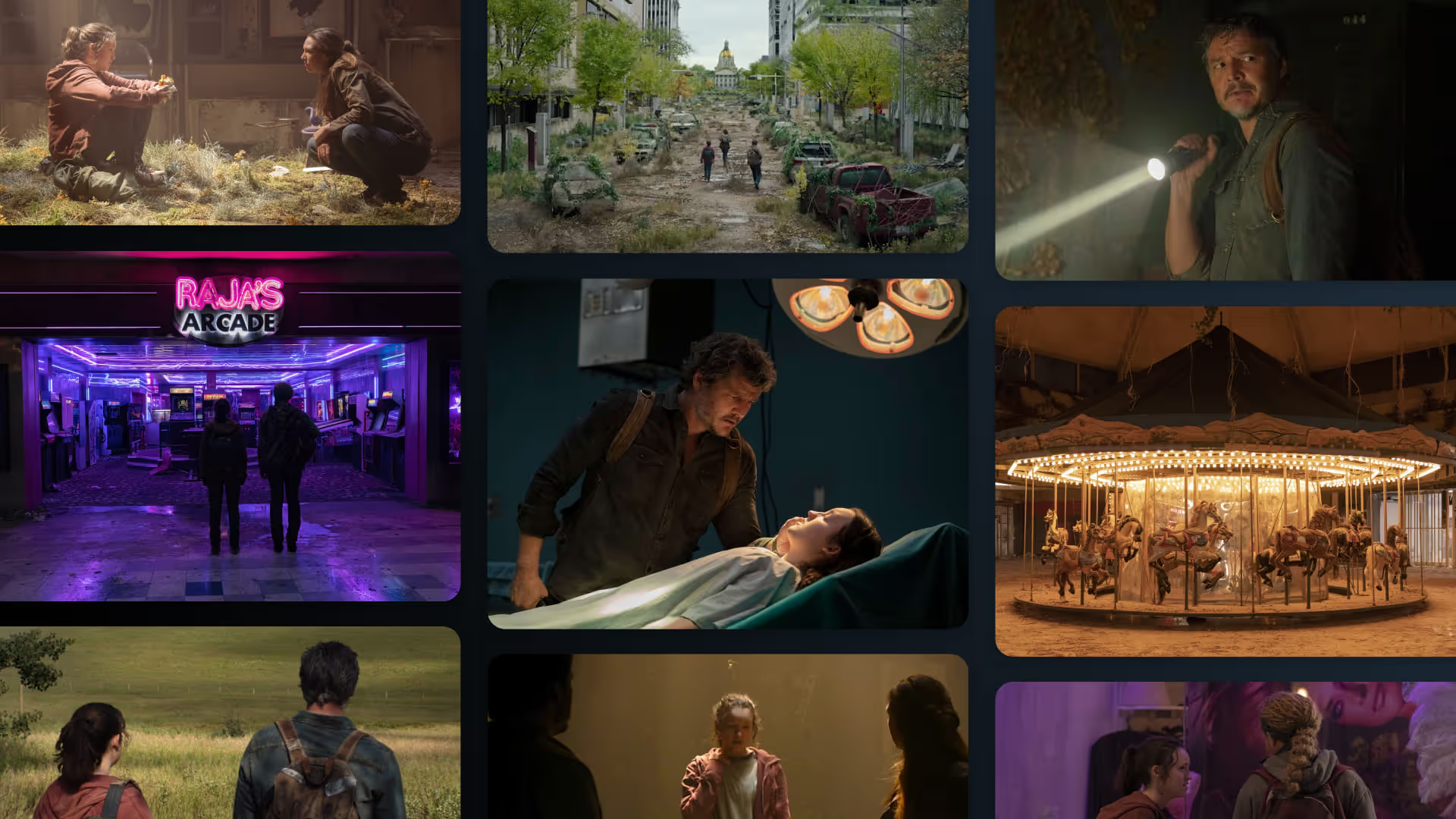
Now, getting into more of the creative side, how was it working with the creators, Craig Mazin and Neil Druckmann?
Spence: Craig and Neil worked together remarkably well. Craig has a tremendous amount of love and respect for the game. They both, separately from each other, really wanted to make it into a TV series. There were places where I think Neil let Craig have his lane, and obviously Craig had a tremendous amount of respect for Neil and what he had made—in the IP and the original building of the characters and all of that.
I think Neil did a great job. He had directed some of the game footage and some of their motion control capture footage and things, but he had never directed a full-on hour of television, and he originally wasn’t planning on doing that. We lost a director early in the show, so Craig had to pick up and direct an episode, and so did Neil. For Neil, it was a new experience, but I thought he did really well, and he seemed really happy with the result. Mark could speak to that because the editor is sitting with the director through that first week. I know that room can be a crucible.
Hartzell: I think Neil is really happy with the end result, and with the show in general. Editing live action was a new-ish experience. The difference between performance capture and directing live action is that [in the former], you can still make a lot of choices as to camera and shot down the road. You can be like, ‘Oh, hey, I think the camera should be here during that moment,’ or ‘I think I want to be there, or there.’ With live action, you have to have done that the one time and gotten things where you wanted them to be. So, that’s thinking about things differently.
When we’re working on the visual effects, oftentimes the editors, the visual effects producers, the showrunners, will be like, ‘Hey, on this visual effects shot, can we switch the camera? Can we look for a different plate to composite this into?’ Neil is used to having that flexibility with all aspects, so that was a limit, but art generally flourishes when you put limits around it. Invention comes from having to figure things out within a construct. So, I think he ended up having a really good experience. He looked at it with a very discerning eye and tried to really think it through and feel it through.
At some point, one of the sound producers from Naughty Dog came into the Evercast room just to watch through the Boston museum sequence, which is the first appearance of the Clickers. This is someone who had worked on the game for, let’s just go with a decade, seeing it for the first time in reality, in real life. He was sort of my first deep fan audience member, and he was like, ‘I can’t believe what I’m seeing because I’ve spent years in this world. I’ve been in this room a thousand times, but not in reality.’ Watching him have that experience—that’s once-in-a-lifetime stuff. How often do you get to do that?
Amazing—and I’m sure that was the case for Neil, too. So, speaking of the museum scene, you talked about this in your session I saw at NAB, Mark, but I’d love for you to share your process in building suspense in that scene.
Hartzell: Well, the most important thing about the Clickers is what you don’t see and what you do see. So you try to elongate and attenuate the moments of fear of the unknown before you make all of the reveals, letting the actors move through space, communicate with each other, communicate with the camera.
The best suspense scenes are built like this. And this one was extraordinary because I think a lot of our viewers had never seen or heard of a Clicker before. A Clicker is something that you usually hear first, and it’s a terrifying, horrifying sound. And then you start imagining what could be making that sound. And then you get to see what makes that sound. This provokes a lot of emotion in people. So, that was a lot of fun.
There was one setup where we got to use visual effects to enhance the moment. That was the moment where originally, we had a Clicker in the background while Joel is reloading. Visual effects allowed us to reimagine that moment and make it so that the Clicker really walked up to camera. So, I think it was the full CG Clicker at that point.
I’ve heard the rumor that in season two, there are going to be more Clickers, because they’re just horrifying and amazing, and one of the most exciting parts of the game. So, yeah, this was such a privilege to get to work on that sequence and that episode.
What do you think people would be surprised to learn about the production of The Last of Us?
Hartzell: Good question. I think a lot of it is out there. We had two episodes get combined into one. Episode one is really episode one and two reimagined with some reshoots and stuff. But that’s been talked about.
Spence: That was actually a very good idea; that was a very smart note. Episode one stood fine on its own, but it was kind of like reading the prologue and being told you couldn’t read the first chapter of the book until next week. I thought they came together really well.
Hartzell: Yeah, because you really wanted to get to the point where the three of them are going into danger, and then technically, the end of the second episode is what the show actually is. Once Tess is removed from the equation, and she’s like, ‘You have to do this,’ that’s the real start of our actual two-person story.
Spence: People might be surprised that, with the exception of a road unit for one sequence at the beginning of what’s now episode four, where they’re driving across the country, that it was all Calgary. Austin was Calgary; Jackson Hole was Calgary; Boston was Calgary. Of course, all of that wide open space was in and around Calgary. I felt like our department’s locations people did a really good job in that way. It’s not one of those shows, I don’t think, where you’re going, ‘That’s not New York City—that’s Toronto!’
Hartzell: I think people would be surprised to know how much of it was shot practically, how many elements were practical, even though they got visual effects enhancement or extensions.
Spence: Yeah, very much an in-camera show.
What are you most proud of regarding your work on this show?
Hartzell: You know, my favorite moment in the episode is right when Ellie has said she’s infected, regarding Tess. Right around that time, there’s a moment where Joel looks back at Tess, and Tess moves towards her lover, her person, and he takes an instinctive step back. The original cut, the first cut, is what’s in the show. Literally, it goes to a 50/50 so you can see the move, wide, and then hits each of them.
And I was like, ‘Oh, that’s my favorite cut.” And then I remember going through it with Neil Druckmann and he was like, ‘Can I see it without that? I wouldn’t have done that wide one there.” So we watched it without, and then he was like, ‘Can I see it again with?’ And he was like, ‘Yeah, let’s just leave that there,’ and I was like, okay. So, you know, I always have a favorite cut. I can almost tell you in each episode I worked on, that’s my favorite—that’s the moment.
Spence: I’m really proud of the fact that it all technically worked out so well. Calgary was a challenge, cloud-based editorial is a challenge. In the first season of a television show, there’s so much you’re figuring out about how it’s going to work. Our editorial workflow ended up unusual and different. The music workflow ended up in a really unusual place that worked really well; our composers got a lot of support from the Sony music team, who were just awesome.
I’m really happy with the main title and how it came out, and that’s always a real challenge that people tend to not want to think about, and you really have to get it in front of people early. There’s no guarantee that you’re going to end up with something you love, but everybody was really happy with where the main title ended up. And so, the way that all of those challenges were surmounted, it came together really well.
And you have the most discerning, hardcore gamer fans, so to be able to impress them on top of everything must really be the icing on the cake.
Spence: Yeah, actually, having done Game of Thrones where a lot of fans just really, really tenaciously loved those books and they’re a big online community, I found the gamer fans generally more gracious, more supportive, and more positive throughout. They were great. But who knows, maybe that just comes from Neil and the Naughty Dog energy because that place just has a really nice feeling to it. It feels like family, and maybe somehow that spreads through the game and through the IP, and infects the fans—pun intended.
Hartzell: If you were a fan of the game and you wanted it to be dramatized, this is probably beyond your wildest dreams of how good it could be.
Spence: Yeah, they did do a really good job of really capturing what was important about the game. I think that’s probably because Craig loves the game so much and Neil did a good job with it. It lends itself to this kind of a show, and I think the audience was probably pleased that it wasn’t going to be a show that felt too much like Walking Dead and too much like a shoot-em-up. It really has those elements, but they aren’t in the forefront.
It obviously resonated with so many people who didn’t play the game, too. Probably because it’s actually a very human story.
Hartzell: Yeah, it’s ultimately a love story and a tragedy; it’s not a zombie thing. It’s a love story and it’s a tragedy.
Create together remotely, in real time


.avif)





.avif)


.avif)
