


Bringing Formula 1 to the big screen meant capturing the sport's precision, speed, and spectacle—while managing a uniquely complex post pipeline. From on-set edits at racetracks around the world to music sessions with Hans Zimmer and Atlantic Records, the team leveraged Evercast to keep the pace.
“I don’t know that there are many projects that are more global than this was—and to be able to access everyone, to be able to come to the same space, was invaluable. We even had one of the music managers in his car on his iPhone watching. It was just a standard: ‘Hey, hop on Evercast.’ Everyone had access to it.
- Matt Sweat, assistant editor
The project
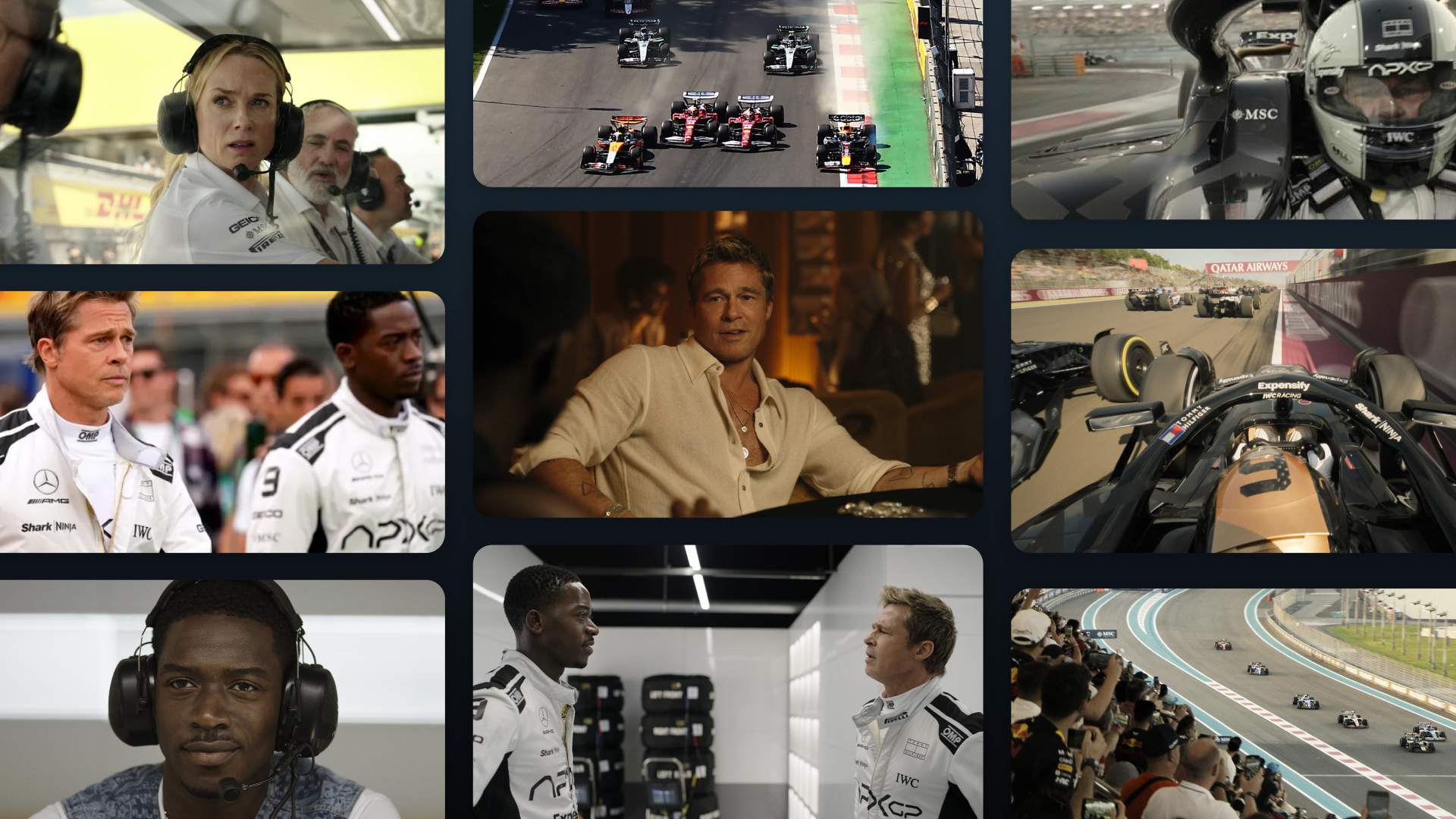
F1 is a Warner Bros. Pictures film directed by Joseph Kosinski and produced by Jerry Bruckheimer. Brad Pitt stars as Sonny Hayes, a racecar driver getting back behind the wheel after a 30-year hiatus in order to revive his former teammate's faltering team. The film was shot at 12+ racetracks around the world, and the combination of practical cinematography and complex visual effects called for a post-production process as fast and flexible as the sport itself.
The team
- Joseph Kosinski, director
- Jerry Bruckheimer, producer
- Stephen Mirrione, ACE, editor
- Matt Sweat, assistant editor
- Hans Zimmer, composer
- Ryan Rubin, music editor (Zimmer’s team)
- Chris Newlin, music editor
- Atlantic Records (Kevin Weaver, Brandon Davis, Joe Khoury)
- DNEG, Industrial Light & Magic, Lola VFX (visual effects vendors)
Challenges
A cutting room on the go
The editorial team was spread between London and Los Angeles. In an unusual arrangement, assistant editor Matt Sweat traveled with the crew to every location during production. Navigating disparate time zones and packed schedules, he was tasked with ensuring that the director stayed in sync with the editor and the rest of the editorial team, while everyone worked oceans apart from each other.
Getting it right
With Formula 1’s enormous, loyal fanbase, the production team was committed to nailing every detail. They arranged for the stunt driver on set to virtually review driving sequences with Lewis Hamilton halfway across the world. They connected the VFX artists and sound designers with the head of Formula 1 in the UK to ensure that the F2 cars they used would pass flawlessly for F1 cars, both visually and auditorily. This kind of attention to detail among a dispersed team meant that their communication and review tools required the utmost precision and reliability.
Scoring the sound of speed
Sound is a main character in a film about Formula 1, but music would also play a huge role in carrying the story from scene to scene. Finding the balance was key. The teams needed to experiment with cues, test songs against picture, and gather feedback from collaborators when they couldn’t always share the same physical space. They needed a solution for review and collaboration that would give them the necessary quality and accuracy to make final decisions.
Security under pressure
Director Joseph Kosinski was especially cautious about footage leaving the cutting room. Ensuring that only the right eyes had access at any given moment was a top priority. The challenge was finding a setup that provided airtight security—controlling how, when, who viewed the material—while still keeping remote collaborators fully in the loop.
The setup
Post-production relied on Evercast as the hub for their global pipeline. On the editorial side, assistant editor Matt Sweat used the NDI (Network Device Interface) function in Avid Media Composer to stream the output signal directly into Evercast without added hardware. This allowed the director and others on set team to seamlessly and securely review cuts live with the team abroad.
Music editor Chris Newlin used his desktop to run Pro Tools, streaming audio through Aux I/O into Evercast, then had Evercast running on his iPad as a separate monitor for video conferencing with Kosinski and the music team, producers, and other collaborators.
The workflow
Editorial: Evercast allowed stakeholders on set to stream content from remote racetracks to London and Los Angeles, where the editor and his team were based, enabling ongoing review and prep despite the global split.
Music: Music editor Chris Newlin used Evercast to show cuts to Zimmer’s studio, execs at Apple and Atlantic Records, and more, running live playback sessions for experimentation and immediate feedback.
VFX: Vendors including DNEG, ILM, and Lola VFX were looped into Evercast reviews, aligning shots and sequences with editorial as they evolved.
Consultation: Whether it was the stunt driver taking notes on technique from Lewis Hamilton himself, or the VFX team running spotting sessions with experts from the real Formula 1, Evercast was a means to review critical content precisely and effectively.
“Evercast played a huge part in protecting the film. Joe was reluctant to send clips out because he didn’t want them floating out in the world. … You can’t get everybody to sign an NDA when they’re looking at things remotely if somebody happens to walk into a room. So being able to stream it via Evercast controls how and when people see it, and who’s seeing it.”
- Chris Newlin, music editor
The results
By integrating Evercast into editorial, music, and VFX pipelines, the F1 team kept an unimaginably complex, international production on track. From on-set edits to studio reviews, Evercast enabled secure, real-time collaboration across continents, giving filmmakers the speed and flexibility to keep up with the fastest sport on Earth.
“Evercast was very helpful in bringing everybody together and unifying the team. ... Between myself, Apple Music, Atlantic Records, and all the different artists, we used Evercast to review scenes and discuss what we were looking for with the songs. ... Evercast became a tool where everybody could collaborate and essentially be in that same room, no matter where they were.”
- Chris Newlin, music editor
Create together remotely, in real time


.avif)






.avif)


.avif)
